Coating Flows
Coating processes begin with the preparation of the coating liquid and deposition of a liquid or liquids onto a solid substrate. Solidification, typically by drying or curing, follows to complete the coating process and create a final product.
In addition to being of tremendous practical importance, coating flows are also at the frontiers of scientific inquiry. Coating flows cover a wide range of length scales from nanometers to meters, involve the presence of free surfaces, and often non-Newtonian rheology. The wide range of length scales mean that interfacial effects play a significant role, so expertise in interfacial phenomena and physical chemistry must be combined with fluid mechanics to address research questions. Because the location of the surface of a coated liquid must be determined along with velocity and pressure fields, coating flows exhibit a rich array of nonlinear phenomena that challenge both experimental observation and theoretical description. Additional nonlinearities are introduced by non-Newtonian rheology, which lead to even more complex behavior and further challenges. Elastohydrodynamic and electohydrodynamic phenomena often play important roles too, as coating processes can involve flexible and deformable solid surfaces as well as electric fields.
The inherent complexity of coating flows demands that a successful research effort involve both fundamental studies on model systems and investigations using actual coating liquids and laboratory-scale equipment. Our research embraces each of these aspects through theory and experiment. Theoretical tools include lubrication theory, stability analysis, and numerical simulation (finite-element, finite-difference, and boundary integral methods). The Coatings Visualization lab contains state-of-the-art facilities for coating flows research.
Read more about Solid Coating Development.
Current research topics
- Slot coating
- Slide coating
- Curtain coating
- Dip coating
- Spin coating
- Multilayer coating
- Tensioned webs
- Gravure printing
- Lithographic printing
- Coating of viscoelastic liquids
- Coating of nanoparticle solutions
Coating Images
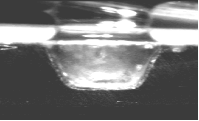

Visualization of flow in a scaled-up gravure cell.
From X. Yin and S. Kumar, Chem. Eng. Sci. 61 (2006) 1146.

Visualization of fountain solution displacement in a model lithographic printing nip.
From R. D. Lenz and S. Kumar, J. Colloid Interface Sci.316 (2007) 660.

Finite-element calculations of streamlines and stress contours in slot coating of viscoelastic liquids.
From O. J. Romero, L. E. Scriven, and M. S. Carvalho, J. Non-Newtonian Fluid Mech. 138 (2006) 63.